
Introduction
Imagine your child not just playing a game, but building the world within it. In the era of digital creation, 3d programming is more than just a technical skill; it's a cognitive breakthrough. For parents looking to future-proof their children’s education, moving from 'flat screens' to 'depth creation' is the ultimate leap in critical thinking. It requires a blend of artistic vision and engineering precision that few other activities can match.
"Children who master 3D spatial reasoning before age 12 are 40% more likely to excel in advanced STEM subjects by high school."
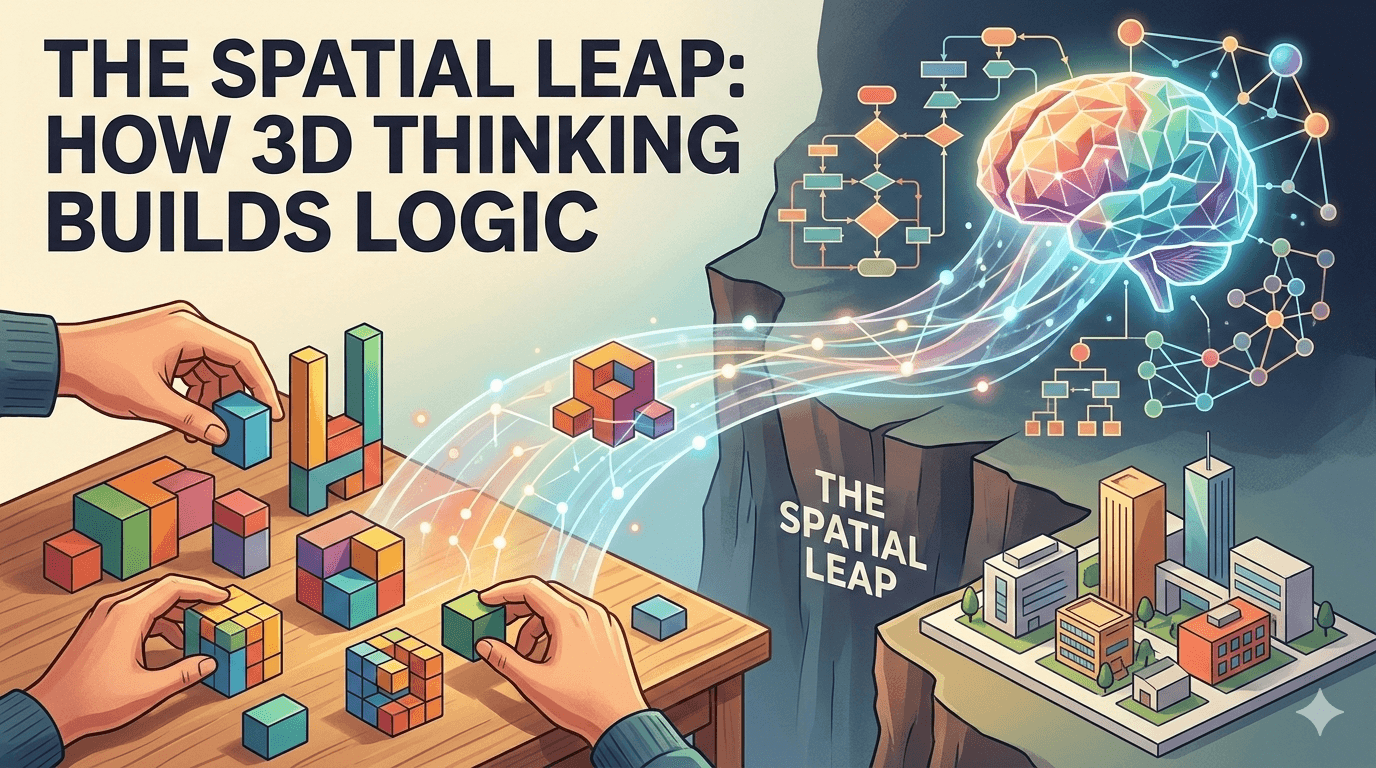
1. The Spatial Leap: How 3D Thinking Builds Logic
Visualizing the invisible through coordinates
3D programming isn't just about making things look "cool." It’s about understanding relationships between objects in a space that has depth, height, and width. When kids engage with 3D tools like Blender, they stop being passive observers and start thinking like architects. They learn to navigate a world defined by X, Y, and Z axes, where every movement is a mathematical choice.
From Players to Architects
Moving beyond flat screens requires a fundamental shift in how the brain processes information. 3D For Kids is the perfect entry point for this spatial revolution, turning abstract math into tangible reality.
-
Spatial Awareness: Understanding how an object looks from multiple angles. This is the foundation of mechanical engineering and architectural design.
-
Geometry in Action: Seeing math come to life through vertices and axes. Instead of just solving X in a textbook, kids see how changing X moves a mountain or a character.
-
Depth Perception: Training the brain to calculate distances and scales in a virtual environment, which translates to better real-world navigation and spatial reasoning.
-
Abstract Thinking: Learning to visualize the invisible — like the internal skeletons (rigging) of a character, which builds a strong mental model for complex systems.
2. Plan, Code, Model: The 3D Creation Loop
When a child builds a 3D character or an environment at Belmans4Kids, they follow a rigorous logical process that mirrors real-world engineering. This iterative loop is where true critical thinking is forged, teaching them to think three steps ahead.
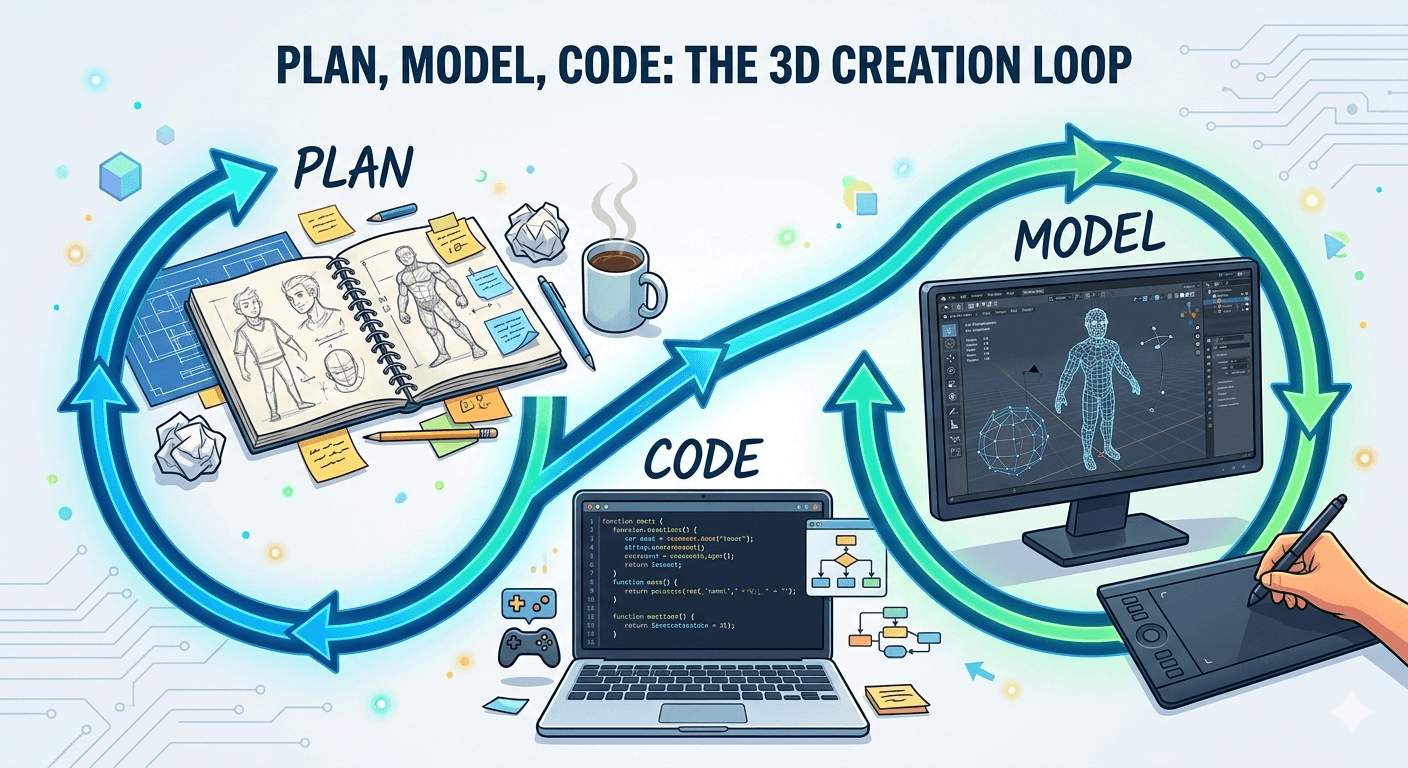
The iterative loop of creation and logic
Planning (Visualization)
They must first "see" the object in their mind and sketch its coordinates in 3D space. This requires foresight and planning — a vital skill in any problem-solving context.
Scripting (Coding)
This is the engine room. Adding code to make the 3D model move, react, or interact requires step-by-step logic. When the code doesn't work, kids learn the art of systematic debugging — building immense resilience.
Modelling (Building)
Shaping the mesh requires extreme precision. If one vertex is out of place, the model's logic breaks. This phase teaches kids that small details matter and that technical accuracy is the backbone of any creation.
3. Mastering the 3D World: Tips for Success

As a parent, you don't need to be a tech expert to support your child's journey. Here are four ways to help them excel in 3D programming and develop their critical thinking skills:
Start with Shapes
Encourage them to build complex things using simple cubes and spheres first. For example, building a simple "robot" made of blocks teaches them how complex forms are just combinations of simple geometry.
Logic over Graphics
Focus on how things move and interact (the code). Ask them questions like, "How does the character know when it hits the floor?" This shifts their focus from art to engineering logic.
The "Undo" Habit
In 3D programming, mistakes are just data. The 'Ctrl+Z' habit isn't about hiding mistakes; it's about the freedom to experiment, fail fast, and iterate until the logic is sound and robust.
Share the Work
Belmans4Kids encourages kids to present their worlds. When a child explains *why* they used a certain script or model structure, they are reinforcing their own logical reasoning and verbal confidence.
"Belmans4Kids provides a structured yet fun pathway for your child to master these tools, giving them confidence in the digital world."
Wrapping Up

🎯 Key Takeaways
- 01 3D thinking boosts mathematical and spatial logic, moving beyond 2D limitations.
- 02 The creation loop teaches persistence, precision, and the art of systematic debugging.
- 03 Modelling combined with coding is the ultimate cognitive workout, preparing kids for AI and robotics.
As we look toward 2026 and beyond, the ability to build and think in three dimensions will be a core digital skill. 3d programming is the bridge that turns a curious child into a future-ready creator, equipped with the critical thinking needed for any career. Whether they become architects, doctors, or software engineers, these skills will be their foundation.
If you're ready to see your child's imagination come to life, Belmans4Kids offers an online enrollment — a perfect, risk-free way to start!
Created by

Kshithij Anand Belman
Tutor, Belmans4Kids
Kshithij Anand Belman is an expert Tutor at Belmans4Kids, giving every child aged 6–16 access to the digital skills that will shape tomorrow — from 3D modelling and game design to app development and AI. He's passionate about making tech education fun, accessible, and empowering for young learners across India, UAE, and Europe.
View Portfolio


